Continuing education
Continuing education in battery technology is offered on demand. We shape it together with you, so that it fits the needs of your company and the background of your employees:
- a single-day or multi-day workshop,
- a full week with laboratory work, or
- topic modules spread over some months.
The content is chosen from the topics below. We have already run this twice for specific industry requirements in the region.
Companies are welcome to contact us if they have a specific interest in battery-related courses. We discuss what your employees need and what we can offer. Contact us. Our BSc and MSc programmes are described on the Education page.
Example: one-week workshop, September 2023
Held at Campus Grimstad on 25 to 29 September 2023, in English, with 20 places. It was open to all battery enthusiasts: it started from the basics and went into detail over the week, and a technical background was an advantage.
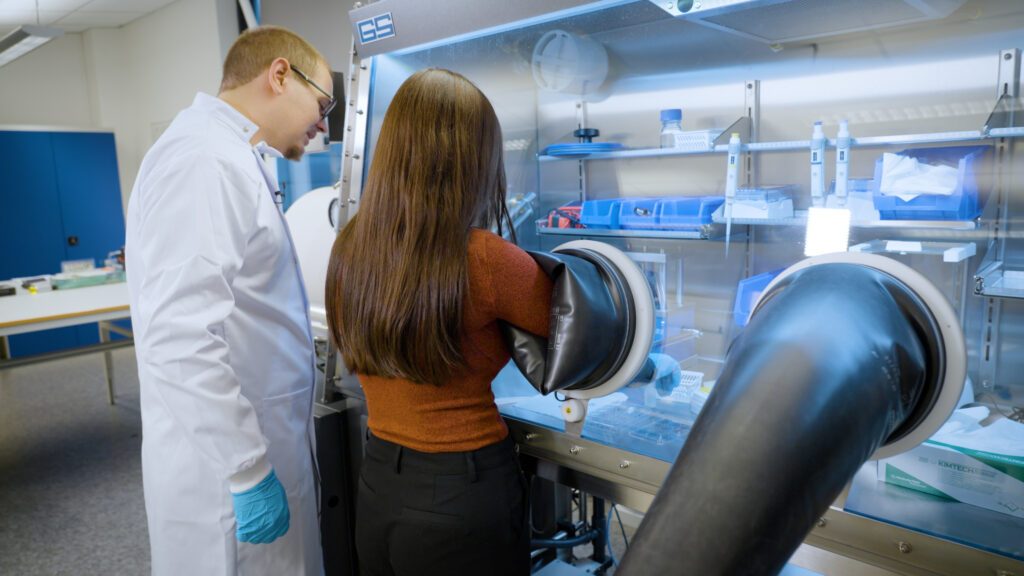
- Monday, from material to electrode: electrochemistry and batteries, lithium-ion batteries, laboratory: making electrodes.
- Tuesday, from electrode to cell: manufacturing and designs of lithium-ion cells, degradation mechanisms (side reactions, capacity fade and resistance increase), laboratory: making batteries. In the evening a social event with Battery Coast industry and academia.
- Wednesday, from cell to operation: advanced characterization techniques, laboratory: data analysis, safety of lithium-ion batteries, exercise: extrapolating from the lab to real life.
- Thursday, battery systems and recycling: battery systems (application, operation control and safety limits, state of charge and health, pack designs), a demonstration of a lithium-ion battery fire with the Grimstad fire brigade, battery recycling.
- Friday, battery economy and ethics: sustainable value chains (circular value chains, life cycle analysis, emissions), ethical and social aspects of battery production, concluding notes and feedback.
What participants learn
- How energy is stored electrochemically in batteries, and what the battery components do.
- An overview of degradation mechanisms in lithium-ion batteries.
- First experience in making a lithium-ion battery at laboratory scale and in analysing battery experiments.
- An overview of how battery systems operate.
- How to explain key battery performance indicators and their physical origins.
- Knowledge of battery recycling routines and approaches.
- Ethical aspects of raw material mining for batteries, and how batteries can be produced sustainably in Europe and Norway.
Experts involved
The 2023 lecturers came from the university and from industry (positions as in 2023):
- Johannes Landesfeind, associate professor at the University of Agder, leads the Battery Coast strategy; background in physics, with academic and industrial research on lithium-ion batteries.
- Gunstein Skomedal, Vianode, and associate professor (20 %) at the University of Agder; material science and material production for lithium-ion batteries.
- Bernhard Fäßler, application engineer at Stadler and researcher (20 %) at the University of Agder; battery systems.
- Martin Choux, associate professor in the mechatronics section of the University of Agder; automated recycling of batteries.
- Reyn O'Born, University of Agder; life cycle assessment.
- Vito Laterza, associate professor at the University of Agder, Department of Global Development and Planning.
- The Grimstad fire brigade, for the demonstration of a battery fire.