

Methods
This library collects the methods used in our teams and the research questions they help to answer.
All methods
BattScape Drag-and-Drop Simulation
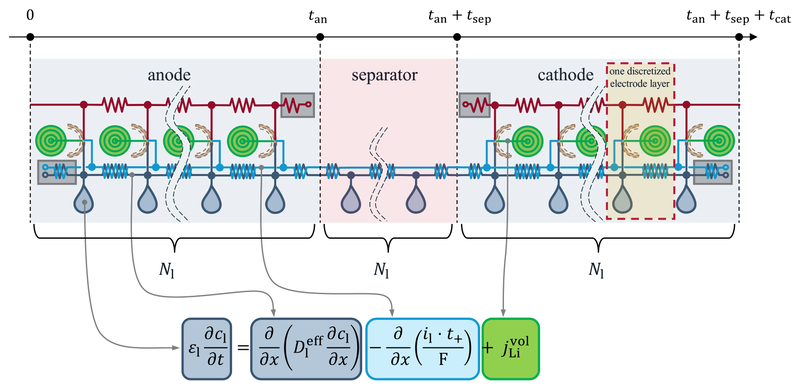
BattScape is our framework for simulating batteries in MATLAB Simscape. A battery model is dragged and dropped together from building blocks for electrodes, separator and electrolyte, from half cells and single-particle models to full cells with blended electrodes, and it runs on a normal laptop. Compared with COMSOL Multiphysics, the voltage of identical cells differs by less than 0.5 mV for charge rates up to 5 C.
Experimentalists can assemble a digital twin of their own measurements without being simulation experts. This helps to design reliable experiments, to find error sources and to understand the electrochemical processes behind a result, and it can be used to adjust the operation of an aging battery, for example to avoid lithium plating.
Reference:
Contact: Johannes Landesfeind, Williams Appiah
Electrolyte Motion Induced Salt Inhomogeneity (EMSI) Tracking
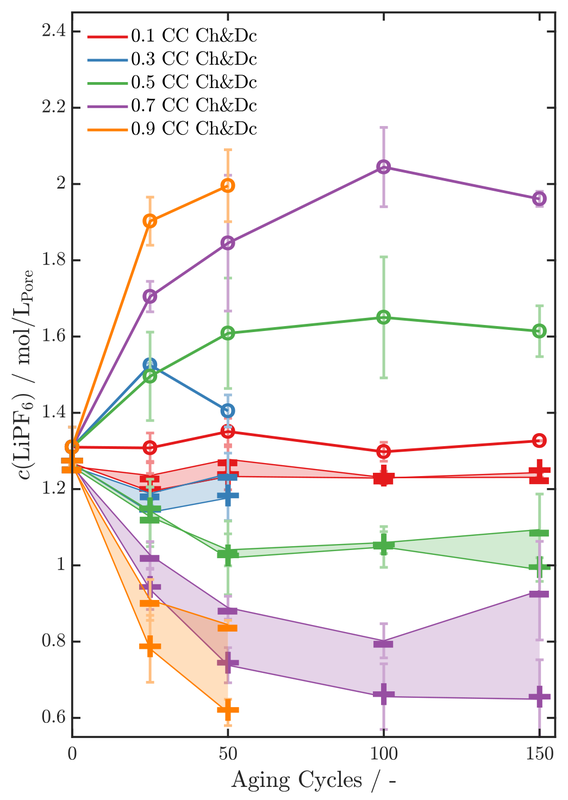
Cells that are charged fast can develop an uneven salt concentration in the electrolyte, caused by the motion of the electrolyte inside the cell (the EMSI effect). We track this salt inhomogeneity in commercial cells while they are charged and cycled, to see how charging conditions such as the C-rate influence it.
The effect can lower the usable capacity within few cycles. Understanding it helps to define charging protocols and cell designs that avoid this early degradation.
Contact: Johannes Wandt, Johannes Landesfeind

Electrolyte Parameters
We measure how well an electrolyte transports lithium ions: its ionic conductivity, salt diffusion coefficient, cation transference number and thermodynamic factor, each as a function of temperature and salt concentration.
These parameters determine how concentration gradients build up in a cell while it is charged or discharged. They are required inputs for physics-based battery models and help to judge which electrolytes allow fast charging.
References:
Contact: Johannes Landesfeind
Entropy Coefficient Estimation
Large-format lithium-ion cells heat up and cool down while they operate, so a physics-based model needs an entropy term in the open-circuit potential. Measuring this entropy coefficient directly is time-consuming and expensive. We estimate it much faster from ordinary (dis)charge data and hybrid pulse power characterization (HPPC), with a least-squares fit of empirical expressions or a data-driven approach. Our open MATLAB toolbox also estimates the open-circuit voltage, from full-cell and half-cell data, and comes with a step-by-step tutorial.
With the estimated entropy coefficient, the Doyle-Fuller-Newman model predicts the cell voltage at different temperatures, in particular at low temperatures, as shown for a 100 Ah prismatic lithium iron phosphate and graphite cell. This makes thermal and electrochemical cell models more accurate, for example for cell design and for optimizing a cell for a given application.
Contact: Svenas Burba, Williams Appiah

Impedance Spectroscopy
Electrochemical impedance spectroscopy (EIS) applies a small alternating voltage or current over a wide range of frequencies and records how the cell responds. We combine it with three-electrode measurements and physically motivated transmission-line models to separate the charge-transfer, pore and contact resistances of the individual electrodes.
The total resistance of a cell hides which process actually limits it. Separating the contributions shows where a cell loses power at high currents or during fast charging, and it provides parameters for battery models.
References:
Contact: Johannes Landesfeind
Isothermal Microcalorimetry
Isothermal microcalorimetry measures the very small heat released by a cell while it is cycled or stored at a constant temperature. The heat is a direct signal of parasitic reactions.
The method is non-destructive and sensitive, so degradation can be followed while it happens. It helps to identify which reactions are responsible and to compare cell chemistries and operating conditions quickly.
Contact: Eric Logan

Microstructural Characterization
Ions have to follow winding paths through the pores of electrodes and separators, which slows their transport. We determine this effect experimentally as tortuosity, from ionic-resistance measurements, and relate it to the microstructure of the electrode.
Estimating tortuosity from the porosity alone can be inaccurate. Measured values make electrode design and battery models more reliable, for example for thick electrodes that are meant to charge fast.
References:
Contact: Johannes Landesfeind
Ultra-High Precision Coulometry
Ultra-high precision coulometry measures how much of the charge put into a cell is recovered, with a precision high enough to reveal very small losses. These losses point to parasitic reactions.
It allows cells, electrolytes and materials to be compared after few cycles. The small losses indicate how long a cell is likely to last, without waiting months or years for ageing tests.
Contact: Eric Logan
Accelerated lifetime
Isothermal Microcalorimetry
Isothermal microcalorimetry measures the very small heat released by a cell while it is cycled or stored at a constant temperature. The heat is a direct signal of parasitic reactions.
The method is non-destructive and sensitive, so degradation can be followed while it happens. It helps to identify which reactions are responsible and to compare cell chemistries and operating conditions quickly.
Contact: Eric Logan
Ultra-High Precision Coulometry
Ultra-high precision coulometry measures how much of the charge put into a cell is recovered, with a precision high enough to reveal very small losses. These losses point to parasitic reactions.
It allows cells, electrolytes and materials to be compared after few cycles. The small losses indicate how long a cell is likely to last, without waiting months or years for ageing tests.
Contact: Eric Logan
Degradation tracking
Electrolyte Motion Induced Salt Inhomogeneity (EMSI) Tracking
Cells that are charged fast can develop an uneven salt concentration in the electrolyte, caused by the motion of the electrolyte inside the cell (the EMSI effect). We track this salt inhomogeneity in commercial cells while they are charged and cycled, to see how charging conditions such as the C-rate influence it.
The effect can lower the usable capacity within few cycles. Understanding it helps to define charging protocols and cell designs that avoid this early degradation.
Contact: Johannes Wandt, Johannes Landesfeind
Impedance Spectroscopy
Electrochemical impedance spectroscopy (EIS) applies a small alternating voltage or current over a wide range of frequencies and records how the cell responds. We combine it with three-electrode measurements and physically motivated transmission-line models to separate the charge-transfer, pore and contact resistances of the individual electrodes.
The total resistance of a cell hides which process actually limits it. Separating the contributions shows where a cell loses power at high currents or during fast charging, and it provides parameters for battery models.
References:
Contact: Johannes Landesfeind
Ultra-High Precision Coulometry
Ultra-high precision coulometry measures how much of the charge put into a cell is recovered, with a precision high enough to reveal very small losses. These losses point to parasitic reactions.
It allows cells, electrolytes and materials to be compared after few cycles. The small losses indicate how long a cell is likely to last, without waiting months or years for ageing tests.
Contact: Eric Logan
Digital twin
BattScape Drag-and-Drop Simulation
BattScape is our framework for simulating batteries in MATLAB Simscape. A battery model is dragged and dropped together from building blocks for electrodes, separator and electrolyte, from half cells and single-particle models to full cells with blended electrodes, and it runs on a normal laptop. Compared with COMSOL Multiphysics, the voltage of identical cells differs by less than 0.5 mV for charge rates up to 5 C.
Experimentalists can assemble a digital twin of their own measurements without being simulation experts. This helps to design reliable experiments, to find error sources and to understand the electrochemical processes behind a result, and it can be used to adjust the operation of an aging battery, for example to avoid lithium plating.
Reference:
Contact: Johannes Landesfeind, Williams Appiah
Operando degradation
Isothermal Microcalorimetry
Isothermal microcalorimetry measures the very small heat released by a cell while it is cycled or stored at a constant temperature. The heat is a direct signal of parasitic reactions.
The method is non-destructive and sensitive, so degradation can be followed while it happens. It helps to identify which reactions are responsible and to compare cell chemistries and operating conditions quickly.
Contact: Eric Logan
Parameterization
Electrolyte Parameters
We measure how well an electrolyte transports lithium ions: its ionic conductivity, salt diffusion coefficient, cation transference number and thermodynamic factor, each as a function of temperature and salt concentration.
These parameters determine how concentration gradients build up in a cell while it is charged or discharged. They are required inputs for physics-based battery models and help to judge which electrolytes allow fast charging.
References:
Contact: Johannes Landesfeind
Entropy Coefficient Estimation
Large-format lithium-ion cells heat up and cool down while they operate, so a physics-based model needs an entropy term in the open-circuit potential. Measuring this entropy coefficient directly is time-consuming and expensive. We estimate it much faster from ordinary (dis)charge data and hybrid pulse power characterization (HPPC), with a least-squares fit of empirical expressions or a data-driven approach. Our open MATLAB toolbox also estimates the open-circuit voltage, from full-cell and half-cell data, and comes with a step-by-step tutorial.
With the estimated entropy coefficient, the Doyle-Fuller-Newman model predicts the cell voltage at different temperatures, in particular at low temperatures, as shown for a 100 Ah prismatic lithium iron phosphate and graphite cell. This makes thermal and electrochemical cell models more accurate, for example for cell design and for optimizing a cell for a given application.
Contact: Svenas Burba, Williams Appiah
Impedance Spectroscopy
Electrochemical impedance spectroscopy (EIS) applies a small alternating voltage or current over a wide range of frequencies and records how the cell responds. We combine it with three-electrode measurements and physically motivated transmission-line models to separate the charge-transfer, pore and contact resistances of the individual electrodes.
The total resistance of a cell hides which process actually limits it. Separating the contributions shows where a cell loses power at high currents or during fast charging, and it provides parameters for battery models.
References:
Contact: Johannes Landesfeind
Microstructural Characterization
Ions have to follow winding paths through the pores of electrodes and separators, which slows their transport. We determine this effect experimentally as tortuosity, from ionic-resistance measurements, and relate it to the microstructure of the electrode.
Estimating tortuosity from the porosity alone can be inaccurate. Measured values make electrode design and battery models more reliable, for example for thick electrodes that are meant to charge fast.
References:
Contact: Johannes Landesfeind