

Team Characterization
We develop methods and cell setups that isolate single effects in batteries, to understand carefully what limits performance, charging speed and lifetime.
Research statement
We focus on understanding and quantifying the electrochemical processes that limit battery performance, charging speed and lifetime. Because these processes influence each other, we develop experimental methods and cell setups that single out individual effects, instead of explaining them from complex, interlinked measurements. Impedance spectroscopy is one of our tools; new cell setups that follow one quantity that other effects can hardly influence are another (see the methods below).
We look carefully at what is commonly assumed to be understood and check the assumptions behind it, to get to the bottom of what happens inside the cell. This gives physically meaningful parameters for battery models, improves their predictive capability, and lets us track degradation during operation.
Research applications
Parameterization of rate-limiting processes
We use experimentally determined parameters to identify and quantify the processes limiting battery performance, including electrolyte transport, ionic resistance in porous electrodes, charge-transfer kinetics, and interfacial resistances. These measurements support physically meaningful parameterization and validation of electrochemical battery models. Examples: electrolyte parameterization, electrode tortuosity.
Tracking degradation of components and materials
We apply electrochemical characterization to investigate how individual battery components and interfaces change during cycling and ageing. By separating contributions from different electrodes and resistance mechanisms, we aim to identify the processes responsible for performance loss and understand their evolution over time. Examples: electrode resistance deconvolution, binder gradients and ionic transport.
Methods
See a full overview of all methods of the Battery Coast group on the Methods page.
Electrolyte Motion Induced Salt Inhomogeneity (EMSI) Tracking
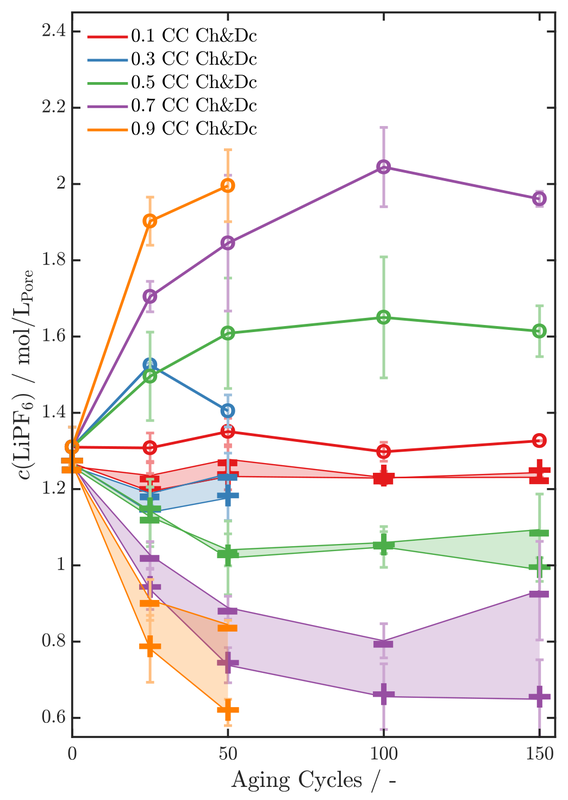
Cells that are charged fast can develop an uneven salt concentration in the electrolyte, caused by the motion of the electrolyte inside the cell (the EMSI effect). We track this salt inhomogeneity in commercial cells while they are charged and cycled, to see how charging conditions such as the C-rate influence it.
The effect can lower the usable capacity within few cycles. Understanding it helps to define charging protocols and cell designs that avoid this early degradation.
Contact: Johannes Wandt, Johannes Landesfeind

Electrolyte Parameters
We measure how well an electrolyte transports lithium ions: its ionic conductivity, salt diffusion coefficient, cation transference number and thermodynamic factor, each as a function of temperature and salt concentration.
These parameters determine how concentration gradients build up in a cell while it is charged or discharged. They are required inputs for physics-based battery models and help to judge which electrolytes allow fast charging.
References:
Contact: Johannes Landesfeind

Impedance Spectroscopy
Electrochemical impedance spectroscopy (EIS) applies a small alternating voltage or current over a wide range of frequencies and records how the cell responds. We combine it with three-electrode measurements and physically motivated transmission-line models to separate the charge-transfer, pore and contact resistances of the individual electrodes.
The total resistance of a cell hides which process actually limits it. Separating the contributions shows where a cell loses power at high currents or during fast charging, and it provides parameters for battery models.
References:
Contact: Johannes Landesfeind

Microstructural Characterization
Ions have to follow winding paths through the pores of electrodes and separators, which slows their transport. We determine this effect experimentally as tortuosity, from ionic-resistance measurements, and relate it to the microstructure of the electrode.
Estimating tortuosity from the porosity alone can be inaccurate. Measured values make electrode design and battery models more reliable, for example for thick electrodes that are meant to charge fast.
References:
Contact: Johannes Landesfeind
BattScape Drag-and-Drop Simulation
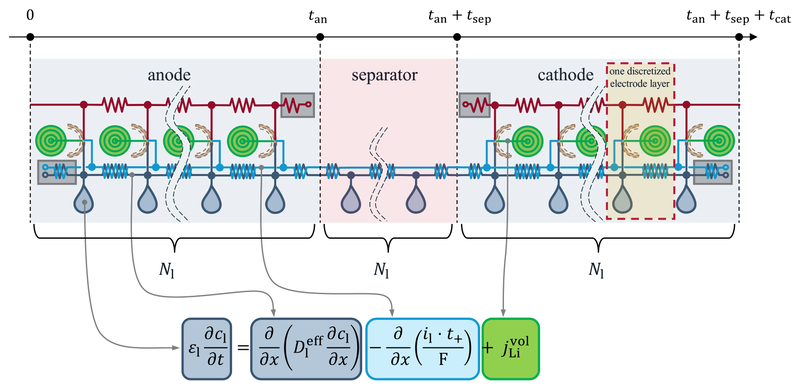
BattScape is our framework for simulating batteries in MATLAB Simscape. A battery model is dragged and dropped together from building blocks for electrodes, separator and electrolyte, from half cells and single-particle models to full cells with blended electrodes, and it runs on a normal laptop. Compared with COMSOL Multiphysics, the voltage of identical cells differs by less than 0.5 mV for charge rates up to 5 C.
Experimentalists can assemble a digital twin of their own measurements without being simulation experts. This helps to design reliable experiments, to find error sources and to understand the electrochemical processes behind a result, and it can be used to adjust the operation of an aging battery, for example to avoid lithium plating.
Reference:
Contact: Johannes Landesfeind, Williams Appiah